Tire Wear Patterns: 5 Common Causes & How to Read Your Tread
Learn how to identify inner wear, center wear, feathering, and cupping on your tires. Spot hidden alignment and pressure issues early. Tact patch, causes center or shoulder tread wear, and reduces driving safety.
Tires are a continuous physical log of your vehicle's mechanical health. Long before an alignment drift causes noticeable steering pull or a worn shock absorber degrades ride stability, specific wear signatures develop across the tread surface. Understanding how to read these patterns allows you to correct underlying pressure, alignment, or suspension issues before a set of tires is permanently ruined.
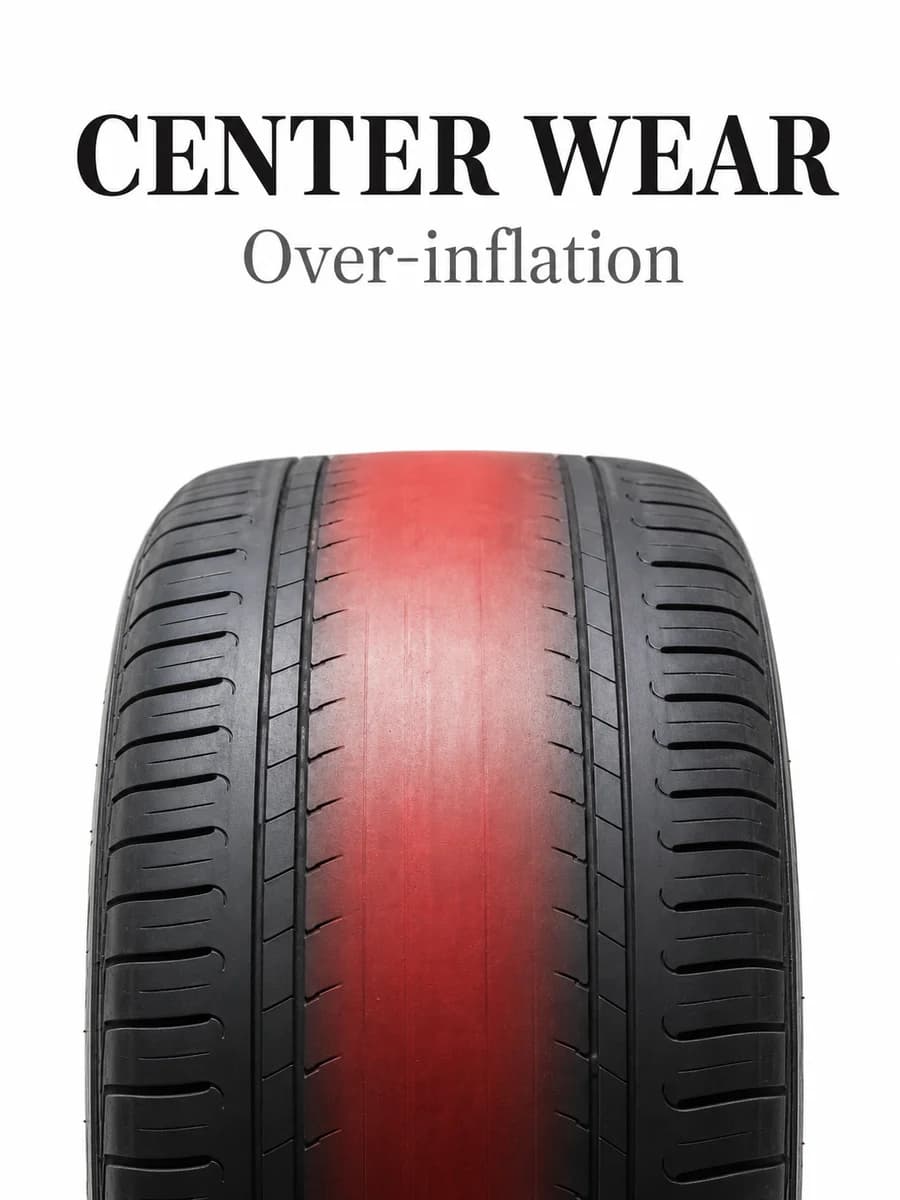
1. Center Wear (Over-Inflation)
- What It Looks Like: The central ribs and grooves show significantly more wear than the inner and outer shoulders.
- Root Mechanical Cause: Operating the tire consistently above the vehicle manufacturer’s recommended cold inflation pressure.
- Why It Happens: Excessive pneumatic pressure increases tension within the tire carcass, causing the center of the tread crown to bulge outward. This convex shape forces the central tread ribs to carry a disproportionate share of the vehicle weight and friction, accelerating center wear while the shoulders make lighter contact with the road.
- What to Check or Do: Adjust your tire pressure when cold to match the Original Equipment Manufacturer (OEM) specifications found on the driver-side door jamb (B-pillar) plaque or in your owner's manual—not the maximum pressure rating stamped on the tire sidewall.
2. Dual Shoulder Wear (Under-Inflation)
- What It Looks Like: Both the inner and outer edges of the tread show heavy wear, while the central tread area retains normal depth.
- Root Mechanical Cause: Running tires below recommended pressure levels, wheel rim bead leaks, or neglected inflation maintenance.
- Why It Happens: Without sufficient internal air pressure to support the center of the tread crown, the tire structure collapses slightly under load. The vehicle's weight shifts outward to the rigid shoulders. As the tire rolls, these outer edges experience excessive flexing and friction, generating localized heat and scrubbing away rubber.
- What to Check or Do: Inflate tires to the correct cold PSI per vehicle manufacturer standards. If a tire repeatedly loses pressure, inspect the valve stem, valve core, and rim flanges for slow air leaks or bead corrosion.
3. One-Sided Inner or Outer Wear (Camber / Alignment)
- What It Looks Like: A smooth, sloped wear gradient across the tread face where only one edge—either the inside or outside shoulder—is worn down.
- Root Mechanical Cause: Incorrect camber alignment or worn suspension components such as control arm bushings, strut mounts, or ball joints.
- Why It Happens: Camber angle refers to the vertical tilt of the wheel relative to the road surface. If the top of the tire leans inward toward the chassis (negative camber), the inner shoulder carries excessive load. Leaning outward (positive camber) concentrates weight on the outer shoulder, scrubbing rubber off that single edge continuously.
- What to Check or Do: Have a professional technician perform a computerized four-wheel alignment to verify tolerance against OEM specifications. Ensure the technician checks for mechanical play in control arm bushings and ball joints before setting alignment angles.
4. Cupping / Scalloping (Suspension Issues)
- What It Looks Like: Repeating, wave-like scoops or scalloped depressions carved around the circumference of the tread blocks.
- Root Mechanical Cause: Worn or leaking suspension dampers (shock absorbers or struts), degraded springs, failing wheel bearings, or severely unbalanced wheels.
- Why It Happens: Suspension dampers control spring oscillation. When damper performance degrades, the wheel micro-bounces vertically at high speeds. Each time the tire slams back onto the road surface after brief vertical travel, extreme localized friction scuffs out a patch of rubber.
- What to Check or Do: Inspect shock absorbers for hydraulic fluid leaks or physical damage, and check wheel bearings for play or grinding noise. Replace worn dampers in axle pairs and dynamically balance the wheel assemblies.
5. Feathering (Incorrect Toe Alignment)
- What It Looks Like: Individual tread blocks wear down smoothly on one side while developing sharp, raised edges on the opposite side. Running your hand horizontally across the tread face feels smooth in one direction and rough—like saw teeth—in the other.
- Root Mechanical Cause: Incorrect toe-in or toe-out alignment setting, often caused by worn tie-rod ends or hard impacts with curbs or potholes.
- Why It Happens: Toe alignment specifies whether a pair of tires points inward or outward relative to the vehicle’s centerline. When toe geometry is out of spec, the tire is forced to travel straight down the road while physically angled sideways. This creates a continuous scrubbing action across the pavement, pushing rubber to one edge of each tread block.
- What to Check or Do: Schedule a steering alignment to reset toe-in or toe-out values to factory specifications. Inspect inner and outer tie-rod ends for mechanical looseness.
⚠️ Why the Naked Eye Often Misses Early Uneven Wear
Sub-millimeter variations in tread depth across a dark, light-absorbing rubber surface are difficult to spot visually under ambient lighting. In early stages, small depth variations across adjacent tread ribs serve as an early diagnostic indicator of minor pressure drift or alignment shifting long before uneven wear becomes severe.
By the time uneven wear becomes obvious to casual visual inspection, a measurable amount of usable tread depth has already been scrubbed away, reducing water evacuation channels and elevating hydroplaning risk.
Wear Pattern Summary
| Wear Pattern | Main Cause | Typical Consequence |
|---|---|---|
| Center Wear | Over-Inflation | Reduced braking traction & harsh ride quality |
| Dual Shoulder Wear | Under-Inflation | Thermal buildup, accelerated shoulder wear & reduced wet grip |
| One-Sided Wear | Camber / Worn Bushings | Directional vehicle pull & premature shoulder loss |
| Cupping / Scalloping | Worn Dampers / Wheel Unbalance | High vibration, cabin noise & increased stopping distance |
| Feathering | Toe Misalignment / Worn Tie Rods | Accelerated tread wear, elevated road noise & steering instability |
Practical Maintenance to Prevent Uneven Wear
Preventing irregular tread wear relies on routine preventative practices:
- Check Cold Inflation Monthly: Always measure tire pressure before driving or at least three hours after parking, adjusting to the values specified on the driver's door-jamb placard or vehicle manual.
- Rotate Tires Regularly: Perform tire rotations every 5,000 to 7,500 miles (8,000 to 12,000 km), or according to your vehicle manufacturer’s recommended schedule, to distribute mechanical wear evenly across all four wheel positions.
- Schedule Annual Alignments: Have wheel alignment geometry and suspension joints inspected annually, or immediately following severe pothole impacts.
Note: Visual or optical surface assessments serve as valuable early screening indicators, but they do not replace a physical mechanical inspection of alignment and suspension components on a lift by a certified technician. Digital surface profiling tools and optical AI can assist during routine checks as screening aids, analyzing surface topography to flag micro-level wear gradients early.